
By enlisting many custom AI agents that collaborate to produce not only rigorous code but also documentation, tests, traceability matrices, and other evidence required in safety-critical software development, a team of two senior engineers was able to produce IEC 62304/ISO 13485-compliant artifacts in days instead of the industry-standard of months (or years) even with larger teams. Demonstrative applications to other safety-critical verticals like aerospace, automotive, space, etc, are underway.
January 14, 2026– Safety-critical software development refers to the process of creating software whose failure could result in death, serious injury, significant property damage, or major environmental harm. This is not the domain of "move fast and break things." Instead, it demands an extraordinarily high degree of rigor, verification, and validation to ensure reliability under all foreseen and sometimes even unforeseen conditions. Examples of industries that rely heavily on safety-critical software development include:
In these high-stakes environments, simply writing functional code is not enough. The bulk of the effort—and the source of massive delays—lies in producing the required evidence: detailed requirements specifications, hazard analyses, architecture documents, unit tests, integration tests, system tests, and a comprehensive traceability matrix linking every line of code back to a requirement and forward to a test case.
The “V-Model”
The traditional approach to safety-critical software development is a highly manual, labor-intensive process often guided by the so-called “V-Model”. The V-Model is a structured approach to software development, often mandated in safety-critical contexts, that emphasizes verification and validation throughout the entire life cycle:
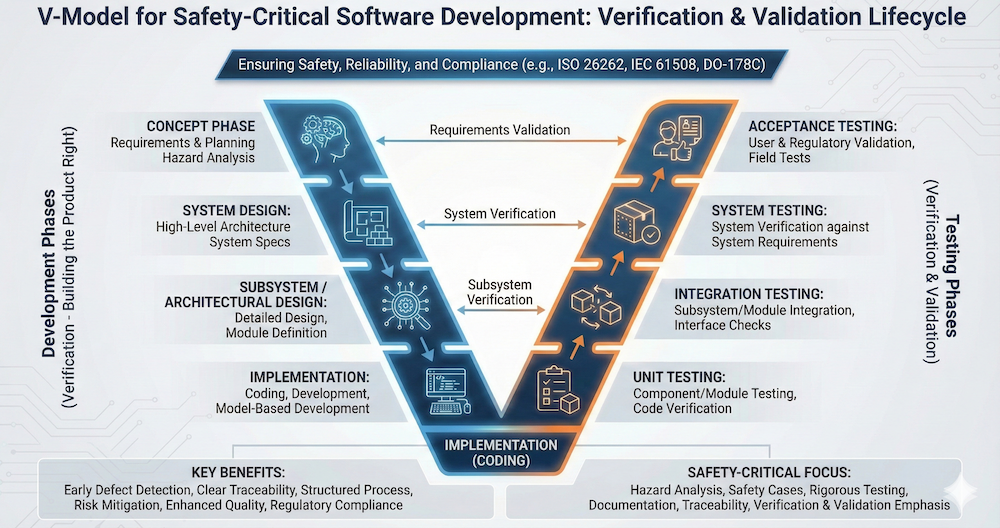
The V-Model dictates that for every phase of decomposition (the left side of the 'V'), there must be a corresponding phase of testing and integration (the right side) that validates the output against the input requirement. This process ensures that the software not only works as intended but is also fully compliant with its original specifications. In its traditional form, the V-Model requires heavy human input and output at each stage of the “V”, where the number of lines in the documentation often overshadows the number of lines of code by one or two orders of magnitude.
SAGE: Spec-driven Agentic Generation with Evidence
Biocogniv’s breakthrough is the creation of a specialized, multi-agent AI orchestration system designed to automate the entire V-Model compliance pipeline. Unlike general-purpose generative AI tools that might assist with "vibe coding" (quick, unverified LLM-generated code), our system is spec-driven. Each agent has a specific role, operating under strict, pre-defined rules that mirror the quality system requirements of standards like IEC 62304 and ISO 13485. And while a human is always in the loop (per most standards requirements), the gains in velocity are extraordinary.
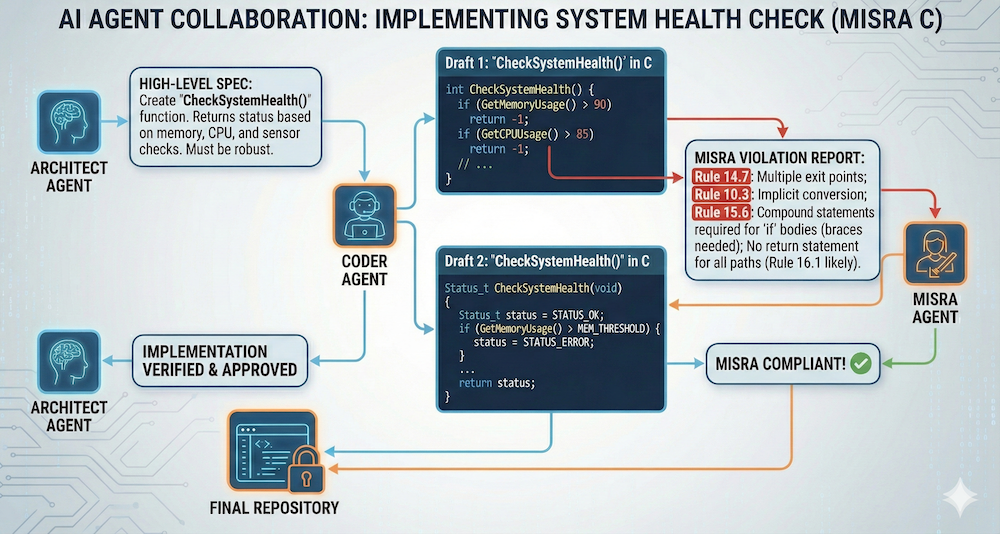
At each step of the V, multiple agents collaborate to produce the necessary artifacts. For example, to translate low-level requirements into code, an Architect Agent might collaborate – and sometimes even have a full on debate! – with a Coder Agent as well as a MISRA Agent to ensure that the code not only satisfies the parameters of the system architecture but also strict MISRA coding rules. In one project, a total of 17 different agents were used to produce IEC 62304-compliant artifacts, where each agent was carefully instructed to comply with a different aspect of the IEC standard. This cohesive, automated workflow ensures that evidence generation is co-produced with the code, eliminating the months of manual effort typically spent on documentation and verification.
Demonstrable Impact and Expert Insight
This agentic approach allowed a small team of two engineers to rapidly produce the complete set of design and V&V artifacts for a crucial component of our medical device software—artifacts that stood up to the scrutiny of ISO 13485 certification audits. The process reduced the timeline from a projected 12-18 months down to mere weeks.
"The leap is in moving from general-purpose assistants to custom, goal-oriented AI agents," says Steve Wallace, CTO of Biocogniv. "’Vibe coding’ might be fast, but it’s antithetical to safety-critical work. Our agents don’t ‘vibe’—they adhere to spec, document every decision, and generate the full compliance package necessary for audit. This leads to reliable, near-deterministic, and traceable AI-driven development."
Artur Adib, PhD, CEO of Biocogniv, emphasizes the significance for regulated industries. "Our compliance and audit success validates the core hypothesis: agentic AI can generate quality system evidence faster and more consistently than human teams alone. We are not just accelerating coding; we are automating compliant generation of all artifacts. By providing this 10x-plus velocity increase, we lower the barrier for innovation in critical sectors like MedTech, Aerospace, and Automotive—fields that can dramatically benefit from faster, safer development cycles."
Looking Forward
While Biocogniv initially proved this system for IEC 62304 and ISO 13485 compliance in MedTech, the underlying agentic architecture is highly adaptable. We are currently demonstrating its application to other safety-critical standards, promising to revolutionize how rigorous software is developed across all regulated verticals.

.svg)
.svg)
